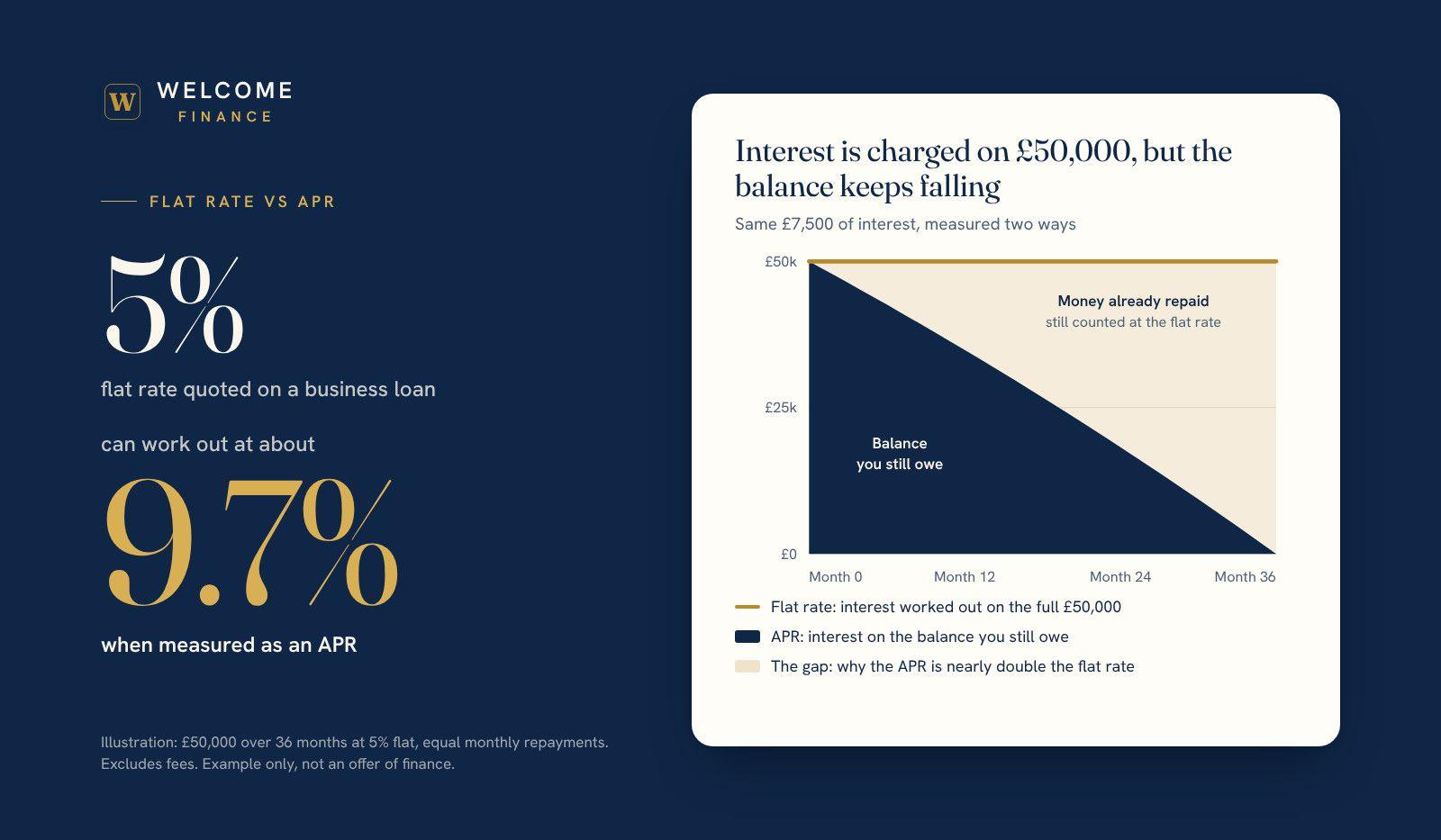
What a flat rate measures
With a flat rate, the lender works out the interest once, at the start, and adds it to the amount borrowed. The calculation is simple:
Total interest = amount borrowed × flat rate × number of years
Take a company borrowing £50,000 over 3 years at 5% flat:
• Interest: £50,000 × 5% × 3 = £7,500
• Total repayable: £50,000 + £7,500 = £57,500
• Monthly repayment: £57,500 ÷ 36 = £1,597.22
Notice what does not change: the interest is £2,500 for every year of the term, including the final year when the company owes very little. That is the whole reason a flat rate looks low.
What an APR measures
APR stands for annual percentage rate. It expresses the yearly cost of borrowing as a percentage of the money you are actually using at each point in the loan. As each repayment reduces what you owe, the interest is worked out on a smaller balance. A full APR also includes compulsory fees, such as an arrangement fee, and allows for compounding (interest building on interest over the year).
For consumer credit, the Financial Conduct Authority sets out exactly how an APR must be calculated (CONC Appendix 1). Lending to limited companies, LLPs and larger partnerships usually falls outside consumer credit rules, so business lenders are free to quote a flat rate, a monthly rate, a factor rate or just a total amount repayable. That freedom is why comparing business finance quotes can be confusing.
Same loan, two numbers: the £50,000 example
The £1,597.22 monthly repayment from the flat-rate example above is exactly what you would pay on a conventional reducing-balance loan at about 9.3% a year (that is the simple annual rate; with monthly compounding it is an APR of about 9.7%). Here is how the two methods spread the same £7,500 of interest over the 3 years:
Year | Amount owed at start of year | Interest the flat-rate way | Interest on the balance actually owed |
1 | £50,000 | £2,500 | £4,020 |
2 | £34,853 | £2,500 | £2,548 |
3 | £18,234 | £2,500 | £933 |
Total |
| £7,500 | £7,500 |
Figures rounded to the nearest pound. Reducing-balance column uses the equivalent rate of 0.776% a month (9.31% a year, APR 9.72%). No fees included.
The total interest is identical. What the APR does is tell you the honest price per pound per year. Over the 3 years the company owes, on average, about £26,850, a little over half of the £50,000 it borrowed. Paying £2,500 a year on an average balance of £26,850 is a rate of roughly 9.3%, not 5%.
Why "nearly double" and not exactly double
Two small effects stop the conversion from being a neat ×2:
• Repayments are monthly. The balance does not fall evenly to zero from day one. You keep the full amount for the first month, so the average balance is slightly more than half.
• Compounding. A true APR treats each monthly rate as building on the last, which nudges the annual figure up. That is why the simple annual rate in the example is 9.31% but the APR is 9.72%.
In practice, for terms between 1 and 3 years, the APR is usually around 1.9 to 1.95 times the flat rate. Over longer terms such as 5 years, the multiple drops slightly.
How the gap grows: three examples over 36 months
The higher the flat rate, the bigger the gap in percentage points, although the multiple stays close to 1.95.
Flat rate quoted | Simple annual rate | APR | APR as a multiple of the flat rate |
3% | 5.7% | 5.8% | 1.94× |
6% | 11.1% | 11.7% | 1.94× |
10% | 17.9% | 19.5% | 1.95× |
Equal monthly repayments paid in arrears over 36 months, no deposit, no balloon and no fees. The amount borrowed does not change these percentages.
For other rates and terms, the flat rate to annual rate calculator in our tools section has a full quick-check table, and the calculator itself works out the figures for any amount and term.
Is a flat rate a worse deal?
Not on its own. A flat rate is a way of describing a price, not a price in itself. In the example, 5% flat and a reducing-balance loan at about 9.3% a year cost exactly the same: £7,500 in interest and £1,597.22 a month. The risk is only in the comparison. If you put "5%" next to "9%" without converting, the flat-rate quote looks almost half the price when it is not.
Flat rates do have one practical feature to be aware of. Because all the interest is fixed at the start, settling early usually saves less than people expect. How much you get back depends on the rebate method in the agreement, so it is worth asking before you sign.
Where you are likely to see each type of rate
How the price is shown | Where it is common | What to watch |
Flat rate | Hire purchase, asset and equipment finance, some short-term business loans | Looks about half the true annual cost |
Annual rate on the reducing balance | Bank term loans, many unsecured business loans | May not include fees; check whether it is fixed or linked to Bank Rate |
APR | Consumer credit (required); some business lenders show it voluntarily | The fullest single figure, but still check fees left out |
Factor rate | Merchant cash advances and some revenue-based finance | A multiplier, not an interest rate; compare the total repayable |
If you are comparing a merchant cash advance, our guide to merchant cash advance factor rates explains how to turn a factor rate into a cost you can compare.
Questions to ask when a quote only shows a flat rate
1. What is the total amount repayable, including every fee?
2. Which fees are there (arrangement, documentation, option-to-purchase) and when are they paid?
3. Is the first repayment taken upfront or one month after the money arrives?
4. Is there a deposit or a final balloon payment?
5. If the company settles early, how is the rebate of interest worked out?
6. Can you give the equivalent APR, or the annual rate on the reducing balance?
With those answers you can put any two quotes side by side on the same basis: the same term, the same cash received and the total cost in pounds.
Frequently asked questions
Is a flat rate the same as an interest rate?
It is an interest rate, but measured on the original amount borrowed for the whole term rather than on the balance you still owe. That is why it looks lower than an APR or a reducing-balance rate for the same loan.
How do I convert a flat rate to an APR?
For a quick estimate on terms of 1 to 3 years, multiply the flat rate by about 1.9. For an exact figure, work out the monthly repayment and find the reducing-balance rate that gives the same repayment, or use a flat rate to annual rate calculator. Remember to add any fees.
Why does settling early save less on a flat-rate agreement?
All the interest is set at the start and spread evenly, but in reality more of it relates to the early months when you owe the most. The rebate you receive depends on the method written into the agreement, so check it before signing.
Do business lenders have to quote an APR?
Usually not when lending to a limited company, LLP or a partnership of four or more partners, because that lending is normally outside consumer credit rules. Many lenders will tell you the APR or annual rate if you ask.
Which figure should I use to compare business finance quotes?
Use the APR including fees alongside the total amount repayable, for the same term and the same amount of cash received. The headline rate alone can mislead in either direction.